
Post, Public Facilities, Waste Management
Public Trash Can Sizes: 4 Key Capacities (60L to 660L)
Jun
Managing public waste effectively is one of the most critical aspects of municipal planning, facility management, and commercial property administration. A key component of this effort is choosing the right bin capacities. The market offers a wide variety of public trash can sizes, ranging from small park receptacles to massive industrial roll-out containers. Selecting the correct size is not merely about finding a bin that fits a physical space; it is about matching waste generation rates with disposal capacities to prevent overflow, minimize collection labor, and maintain environmental cleanliness.
If public bins are too small, they overflow rapidly, causing litter problems and health hazards. If they are too large, they waste budget, occupy valuable space, and collect stagnant garbage that generates foul odors. In this comprehensive selection guide, we examine the four standard public trash can sizes—60L, 120L, 240L, and 660L—explaining their unique characteristics, ideal applications, and how to select the best capacity for your public spaces.
Why Selecting the Right Capacity Matters
The size of a public bin dictates its operational efficiency. When choosing public trash can sizes, facility managers must balance the collection frequency against the volume of waste generated by pedestrians and visitors. An under-sized bin requires constant monitoring and high-frequency emptying, which dramatically increases labor costs. Conversely, over-sized bins might seem convenient, but they encourage the accumulation of large volumes of waste over long periods. In warm climates, this leads to rapid organic decomposition, leading to pest infestations, insect breeding, and severe odor issues.
Additionally, very large bins can block pedestrian traffic or disrupt the visual harmony of parks and commercial plazas. Therefore, selecting the appropriate bin size involves an assessment of the environment’s foot traffic, waste types, and collection infrastructure.
Standard Public Trash Can Sizes and Their Applications
1. The 60-Liter (60L) Trash Can: Compact and Discrete
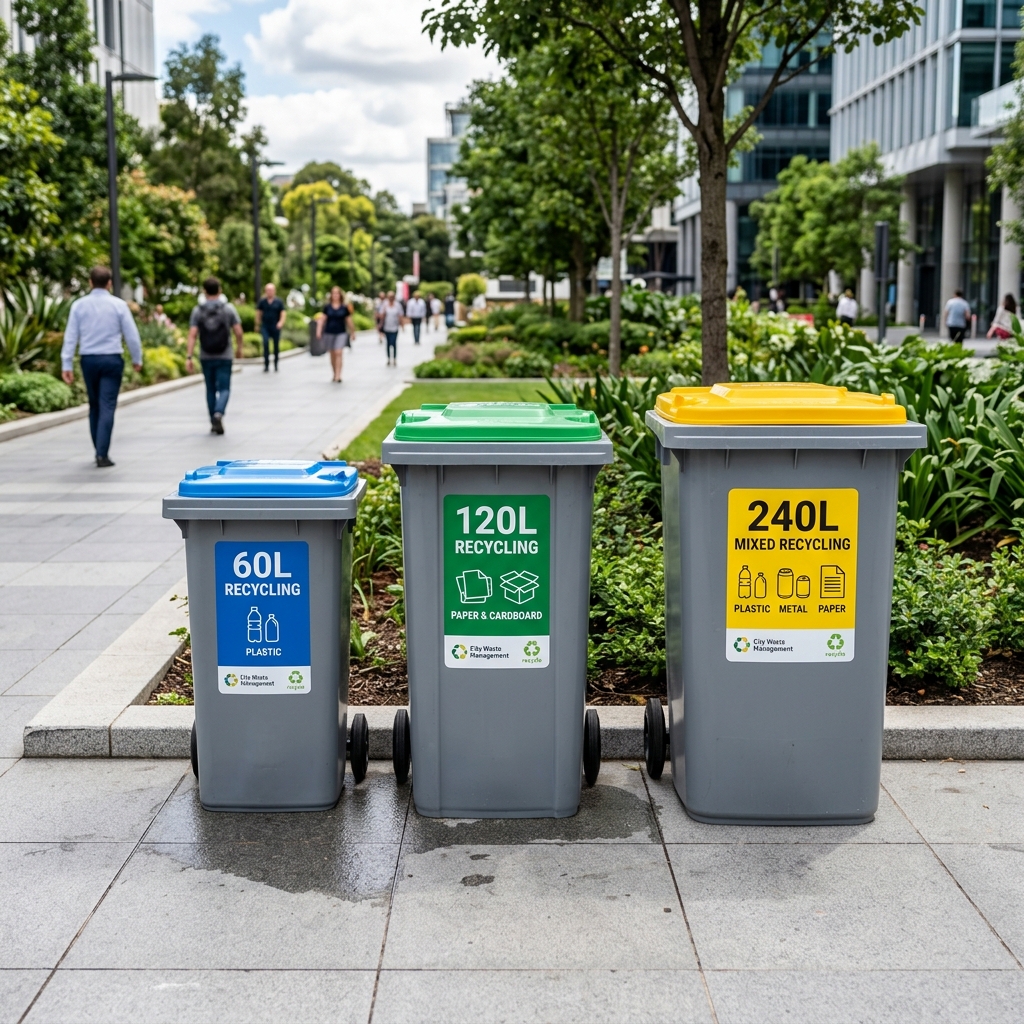
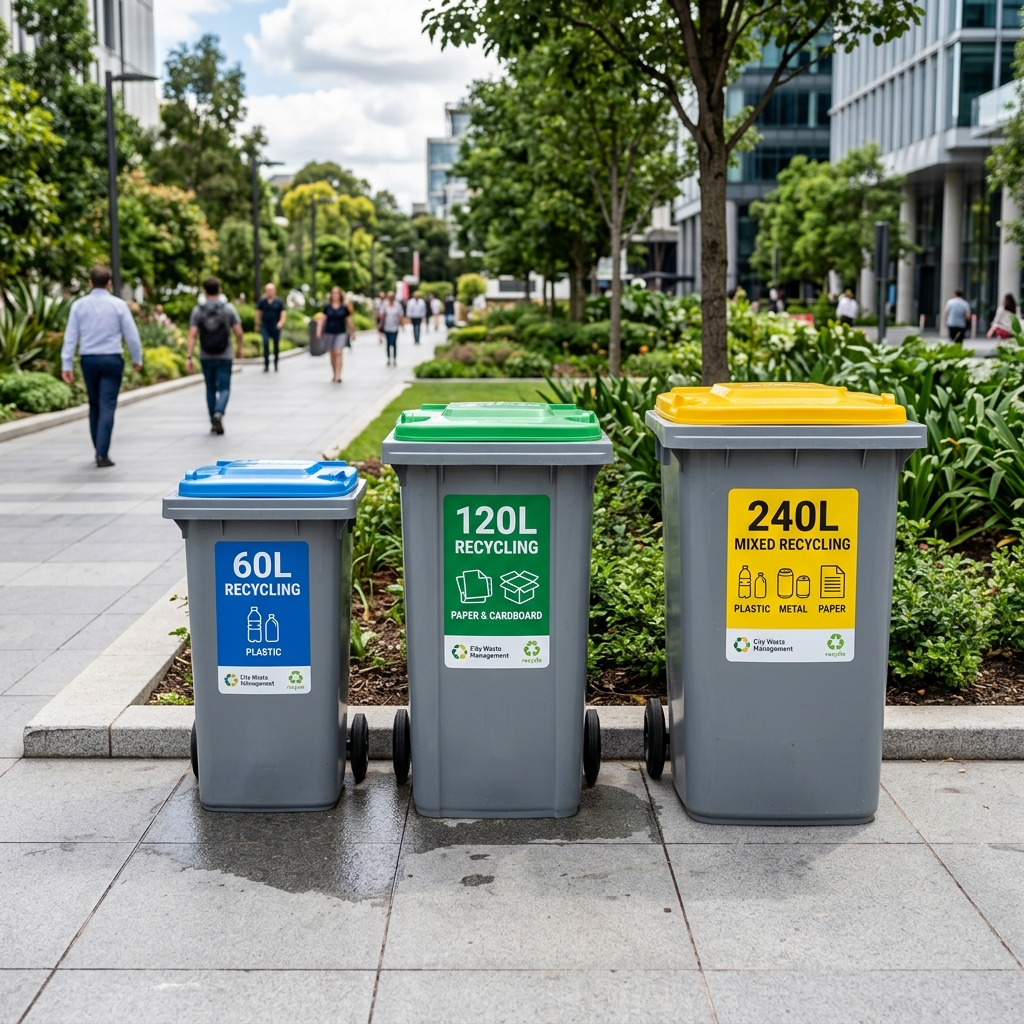
The 60-liter public trash can is the smallest standard size used in public and semi-public environments. Typically standing about 60 to 70 centimeters tall, these bins are compact and discrete, making them ideal for indoor public areas, office hallways, hotel lobbies, and restrooms. They are also widely deployed in low-traffic outdoor areas like park pathways, resort walkways, and private garden seating. A 60L capacity is sufficient for disposing of lightweight waste, such as paper cups, snack wrappers, and tissues.
Because of their limited volume, they are easy to lift and empty manually without specialized lifting machinery. However, they are not suited for high-traffic zones or places where visitors dispose of large food containers or bulky items.
2. The 120-Liter (120L) Trash Can: The Versatile Workhorse
The 120-liter trash can is a highly versatile option that bridges the gap between light-duty indoor bins and heavy-duty outdoor containers. It offers a moderate capacity that can handle typical daily waste volumes in medium-traffic locations, such as retail stores, school campuses, office complexes, and public bus stops. Many 120L models are equipped with wheels, which allows cleaning staff to transport waste easily across facilities. This size is large enough to hold multiple bags of household or commercial waste but remains compact enough to be stored in small service alcoves.
In terms of public trash can sizes, the 120L bin is highly popular for municipalities implementing dual-stream recycling, where separate 120L bins are placed side-by-side for trash and recycling.
3. The 240-Liter (240L) Trash Can: The Municipal Standard
If you walk down a city street, visit a municipal park, or walk through a residential neighborhood on collection day, you are highly likely to see a 240-liter trash can. This size is the gold standard for outdoor municipal and commercial waste management. With a capacity that is double that of a 120L bin, the 240L bin is designed to handle high volumes of waste in busy areas like central plazas, major public parks, boardwalks, and commercial districts.
These bins are constructed from heavy-duty, UV-stabilized plastics or metal and feature robust wheels and handles. Crucially, 240L bins are designed to be compatible with the mechanical lifters on municipal garbage trucks, allowing for rapid, semi-automated collection that reduces strain on sanitation workers.
4. The 660-Liter (660L) Trash Can: High-Volume Commercial Capacity
The 660-liter trash can is a heavy-duty industrial container designed for areas that generate massive amounts of waste. Unlike smaller wheeled bins, the 660L bin features four swivel wheels with brakes and a wide rectangular footprint. This size is not typically placed on pedestrian streets for public use; instead, it is positioned in centralized waste accumulation zones, such as behind restaurants, in resort loading bays, outside apartment complexes, and near major event venues.
The 660L container acts as a collection point where smaller 60L and 120L bins are emptied throughout the day. It requires mechanical hydraulic lifters for emptying and is constructed from reinforced plastics to withstand high impact and heavy loads.
Critical Selection Criteria for Public Facilities
To choose the correct public trash can sizes, you should evaluate three main factors. First is foot traffic density. High-density pedestrian areas, such as transit hubs and tourist spots, require 240L bins at minimum to avoid daily overflows. Low-traffic walking paths can be served adequately by 60L or 120L bins. Second is the collection schedule. If your maintenance team can only collect waste once a week, larger bins are essential. If you have daily trash sweeps, smaller bins are preferable as they keep waste fresh and reduce visual clutter.
Third is waste composition. Areas near food courts and cafes generate large, wet, and bulky waste, demanding larger bins with secure lids to contain odors. Office environments generate mostly paper and dry waste, allowing for smaller, open-top models.
Conclusion
Selecting the right public trash can sizes is a simple yet impactful decision that determines the cleanliness and efficiency of any facility or community. By choosing the compact 60L bin for indoor areas, the versatile 120L bin for medium-traffic zones, the standard 240L wheelie bin for public streets, and the large 660L container for centralized waste collection, you can establish an organized waste management system that keeps public spaces beautiful and clean for everyone.
Frequently Asked Questions
What is the most common size for outdoor street trash cans?
The 240-liter (240L) bin is the most common size for municipal street waste management. It provides a large capacity that prevents overflow while remaining compatible with standard garbage truck mechanical lifting systems.
How many trash bags fit in a 120L public trash can?
A 120L trash can typically holds about 2 to 3 standard-sized kitchen trash bags (approx 30-40 liters each). It is ideal for moderate waste environments before requiring emptying.
Can a 660L public trash can be moved manually?
Yes, 660L bins are equipped with four heavy-duty swivel wheels and ergonomic handles, allowing them to be pushed manually by maintenance staff over flat surfaces. However, they should not be moved manually when filled with extremely heavy materials.
Related Reading: Explore our detailed guide on 2 and 3 Compartment Selection Guide to learn more about choosing the best waste solutions for your needs.
To understand the global impact of proper recycling and garbage disposal, check out the comprehensive resource on Waste Management on Wikipedia.
